










Molybdenum Disilicide (MoSi2)
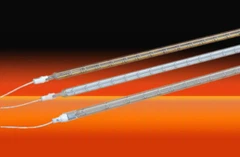
Molybdenum disilicide is a refractory cermet (ceramic-metallic composite) primarily used as a heating element material. This is a desirable material for high-temperature furnaces due to its high melting point and good corrosion resistance. Molybdenum silicide heating elements are produced by various energy-intensive processes such as mechanical alloying, combustion synthesis, shock synthesis, and hot isostatic pressing.
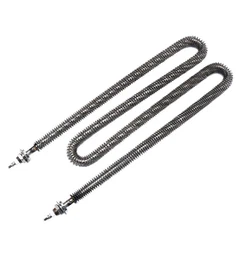
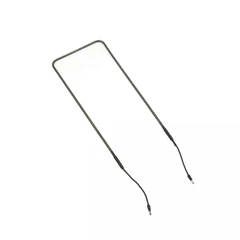
MoSi₂ type heaters can achieve heating temperatures up to 1,900°C. Downsides for using molybdenum silicide are its low toughness at ambient conditions and high-temperature creep. Its brittleness at room temperature necessitates very careful handling. Increased toughness is achieved at its brittle-ductile transition temperature around 1,000°C. A higher creep rate, on the other hand, causes the heating element to easily deform at high temperatures. The most common type of MoSi2 element is a 2-shank hairpin design, that is usually suspended through the roof of a furnace, and located around the furnace walls. Other shapes are available often combined with ceramic insulation formers that provide both mechanical support and thermal insulation as an integrated package.
Silicon Carbide (SiC)
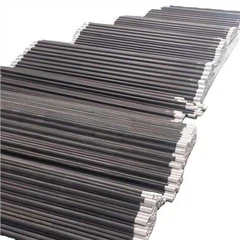
This is a type of ceramic produced by recrystallization or reaction bonding of SiC grains at temperatures above 2,100°C. Silicon carbide heating elements are porous bodies (typically 8-25%) where the furnace atmosphere can react through the cross-section of the material. The whole heating element may be gradually oxidized which leads to an increase in the electrical resistance properties of the elements over time (commonly referred to as “aging”) A variable voltage supply is usually required to maintain the desired power output from the elements by gradually increasing the voltage to the elements during their lifetime. This aging eventually limits the life and performance of the heating element.
Silicon carbide has many properties that make it suitable for making heating elements for very high service temperatures. This ceramic has no liquid phase. Meaning that elements will not sag or deform due to creep at any temperature, and no supports are required inside the furnace. SiC directly sublimates at temperatures around 2,700°C. Moreover, it is chemically inert from most process fluids and has high rigidity and a low coefficient of thermal expansion. Silicon carbide heaters can achieve around 1,600 to 1,700°C heating temperatures.
Graphite
Graphite is a mineral composed of carbon wherein the atoms are arranged in a hexagonal structure. This mineral, also its synthetic form, is a good thermal and electric conductor. Graphite can generate heat at temperatures greater than 2,000°C. At high temperatures, its electric resistance significantly increases. Moreover, it can withstand thermal shocks and does not become brittle even after rapid cycles of heating and cooling. The main disadvantage of using graphite is its tendency to oxidize at temperatures around 500°C. Continued use at this range eventually results in the consumption of the material. Graphite heating elements are typically used in vacuum furnaces where oxygen and other gases are evacuated from the heating chamber. The absence of oxygen not only prevents oxidation of the molten metals, but also the heating element itself.
Molybdenum, Tungsten, and Tantalum
These are refractory metals with similar properties as graphite when used as heating elements. Among these metals, tungsten has the highest operating temperature but also more expensive. In terms of viability, molybdenum is more popular since it is the least expensive but is still more expensive than graphite. Like graphite, they can only be used in vacuum conditions since they have a strong bonding affinity with oxygen and even hydrogen and nitrogen. They begin to oxidize at temperatures around 300 to 500°C.
Positive Thermal Coefficient (PTC) Materials
Typical PTC material is rubber but can be ceramics as well. PTC rubber is made of polydimethylsiloxane (PDMS) with carbon nanoparticles. PTC heaters have a unique property in which the heater maintains or limits the current flow by having an increased electrical resistance as the temperature increases. This makes the material safe and suitable for use in clothing. Initially, the heater draws full power and heats up due to its resistivity. The material’s resistance increases with the rising heat and then acts as an insulator. This is achieved without the need for any feedback loop.