














Data Sheet
|
No. |
Main Parameter |
|
|
1 |
Model No. |
WNA-147 |
|
2 |
Voltage |
220-240V |
|
3 |
Material |
316L |
|
4 |
Power |
2000W |
|
6 |
Length |
as you required |
|
7 |
Flange size |
1 1/4" brass flange |
|
8 |
Certificate |
CE.IEC60730 |

Description
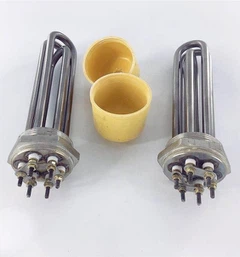
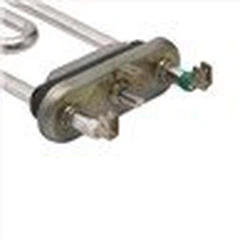
Flange type immersion heater element is typically more durable and designed for higher temperature and pressure conditions.
It can be made of various materials such as copper, stainless steel, and zinc-plated copper, each offering different levels of corrosion resistance and longevity.
It is designed for using in tanks and pressurized vessels to heat both gases and liquids. It will typically mate with a companion flange that is either welded to a tank or in the case of circulation heaters, to a pipe body.It is designed to provide our customers with a long-lived, dependable, trouble-free heater for their application requirements. A properly designed flanged heater will provide a high degree of efficiency as the energy that is generated is quickly dissipated directly into the medium that is being heated.
The shape of the flange can be round flange,squre flange and hexagonal flange.
The thread of the hexagonal flange type heater is 1",1.5" and 2",some can be customized.
The connection way of the flange type heater is star connection or corner connection.
During the usage process, sometimes leaks will happen in flange type immersion heater element. This not only affects the heating effect but may also pose safety hazards to the production equipment and working environment. Below we will explore the causes of leakage and the corresponding solutions.
The causes are as below:
1. Quality issues of the flange type immersion heater element itself: If there are problems in the manufacturing process , such as weak welding or substandard materials, it will lead to a loose connection between the tube body and the flange, resulting in water leakage.
2. Excessive temperature: During the operation, if the temperature is too high, it will cause the tube body to deform and twist, resulting in gaps at the connection between the tube body and the flange, and thus causing leakage.
3. Aging of the tube: After long-term use, the heating tube may experience corrosion, wear and other phenomena, which will lead to a reduction in the thickness of the tube body, loosening at the connection points, and eventually leakage.
4. Damage at flange connection: The sealing gasket or screws at the flange connection may show signs of wear and aging, which can cause the flange connection to no longer be sealed, thereby leading to water leakage.
Solutions
1.Regular inspection: regularly checking whether there is corrosion, wear and other phenomena on the surface of the immersion heater element, checking if the flange connection is loose or the sealing gasket is aged, etc.,it is helpful for timely detection and handling of leakage problems.
2. Replace the sealing gasket and screws at the flange connection: If wear, aging or other problems are found in the sealing gasket and screws at the flange connection, they should be replaced in time.
3. Control the working temperature of the heating element: When using flange type immersion heater element, it is necessary to pay attention to controlling the working temperature of the heating tube to avoid excessively high temperatures, which may cause problems such as deformation and twisting of the tube body.
4. Quality Assurance: Select a reliable flange electric heating tube manufacturer and strictly control the quality of the heating tubes to ensure that the manufacturing quality of the heating tubes meets the requirements.
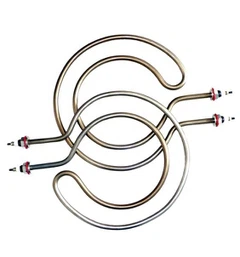
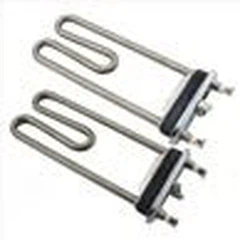
Regarding the bent type flanged immersion heaters,the size and shape of the flange can be changed.
The heating tune and flange can be connected by argon arc welding machine, and the method of tightening the equipment can also be used, that is, each heating pipe is welded on the standard part, and then the flange cover is tightened with nuts, and the pipe is connected with the standard part by argon arc welding machine, without leakage. The sealing of standard parts adopts reasonable processing technology, single disassembly is very convenient, and greatly saves the maintenance cost.
The bent type flanged immersion heater is suitable for open, closed saturated solution tank and cycle heating applications, its surface output power is large,which is 2-4 times larger than the surface load of the gas heating.
Advantage
Why flange style is the most popular electric water heating element
Most industries have a need for heated water, whether for use in boilers, comfort heating or other processes around a facility, it's important to have an efficient way to get access to boiling water whenever it's needed. That's why most industries rely on a flange style water heating element. It's one of the most efficient and simple methods of heating up water.
The Highly Efficient Water Heating Element
If you're looking for the most efficient way to heat up water an electric heating element is one of the best options available. Electricity has long been known as one of the best ways to heat water, especially when used in combination with a submerged element like a flange water heating element. These products rely on electric resistance to generate heat that's quickly transferred over to water.
Heats above Boiling
Most of these heaters are designed to heat at above 230 degrees Fahrenheit to ensure that the water is fully boiled and transformed to steam. There are passive heaters designed to operate at low levels of pressure and direct heaters that can operate at much higher pressure levels needed in more intense applications.
Precise Temperature Control
Another nice benefit of relying on an electric heater is that you have precise control over the temperature output. Most of these units are attached to RTDs and digital thermocouples to give you exact temperature controls. This is much harder to achieve with a gas unit, which is why electric heaters are often used in environments that demand absolute precision.
Simple Maintenance
One of the key benefits of the flange style elements is how easy they are to maintain. You install one of the elements right into the tank or tubing where you'll heat up water and when changes have to be made you simply remove the pressure from the system and unbolt the element to pull it out. It's that easy. You can access the element in mere moments and you don't have to take anything apart. That's why so many facilities prefer the flange heating element.

Workshop


Hot Tags: Flange type immersion heater element, China, suppliers, manufacturers, factory, customized, wholesale, free sample, made in China, Flanged Immersion heating element, Flange Heating Element with free nut, 380V Flange Type Water Heater Element, SS304 Immersion flange heating element, Incoloy Flange Mounted Heater Element, IP55 flange heating element


