

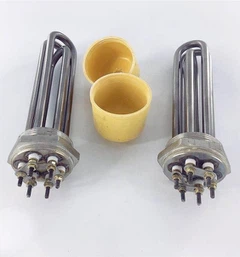
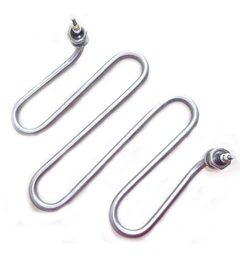
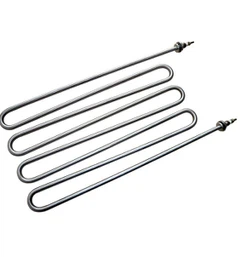


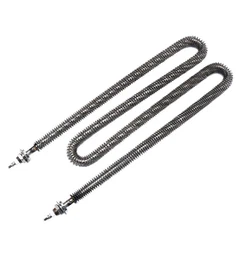
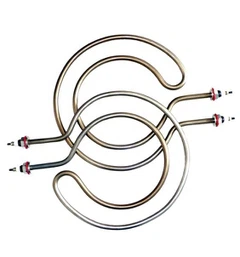


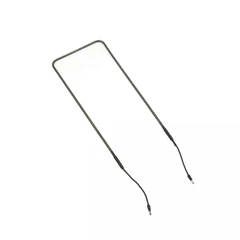







Hey there! As a supplier of finned heating elements, I often get asked about the difference between straight and helical fins in heating elements. Today, I'm gonna break it down for you in a simple and easy - to - understand way.
What are Finned Heating Elements?
First off, let's quickly go over what finned heating elements are. These are basically heating elements with fins attached to them. The fins serve to increase the surface area of the heating element. This increased surface area allows for better heat transfer. When more surface area is exposed to the surrounding medium (like air or a liquid), heat can be transferred more efficiently.
Straight Fins in Heating Elements
Let's start with straight fins. Straight fins are exactly what they sound like - they're fins that run in a straight line along the heating element.
Advantages of Straight Fins
One of the biggest advantages of straight fins is their simplicity. They're relatively easy to manufacture. Since they have a straightforward design, the production process is less complex compared to some other fin types. This simplicity also means that they're generally more cost - effective to produce.
Straight fins are great for applications where the flow of the medium (air or liquid) is in a straight and unidirectional path. For example, in some industrial ovens where the air is circulated in a straight line, straight fins can efficiently transfer heat to the air. They can also be very effective in applications where space is limited. Because of their linear design, they can be easily placed in narrow spaces without taking up too much room.
Disadvantages of Straight Fins
However, straight fins do have their drawbacks. In situations where the flow of the medium is turbulent or has multiple directions, straight fins may not be as effective. The straight design doesn't do a great job of mixing the medium, so heat transfer might not be as uniform. Also, compared to some other fin designs, straight fins may not provide as much surface area for a given length of the heating element.
Helical Fins in Heating Elements
Now, let's talk about helical fins. Helical fins are fins that are wound around the heating element in a spiral pattern.
Advantages of Helical Fins
Helical fins are excellent at promoting turbulence in the medium. When the medium (air or liquid) flows over the helical fins, the spiral shape causes the medium to swirl and mix. This increased mixing leads to more uniform heat transfer. In applications where uniform heating is crucial, like in some chemical processes or in certain types of HVAC systems, helical fins are a great choice.


Another advantage is that helical fins can provide a larger surface area for heat transfer compared to straight fins of the same length. The spiral design allows for more fin material to be packed into a given space, which means more heat can be transferred.
Disadvantages of Helical Fins
The main disadvantage of helical fins is their complexity. They're more difficult to manufacture compared to straight fins. The winding process to create the helical shape requires more precise machinery and skilled labor. This makes them more expensive to produce. Also, in some cases, the increased complexity can lead to more maintenance requirements. If a helical fin gets damaged, it can be more difficult to repair compared to a straight fin.
Real - World Applications
Let's look at some real - world applications to see how these two types of fins are used.
Straight Fins in Applications
As I mentioned earlier, straight fins are commonly used in industrial ovens. In these ovens, the air is usually circulated in a relatively straight path. The straight fins can efficiently transfer heat to the air, which then heats up the products inside the oven. They're also used in some small - scale heaters, like the Stainless Steel Finned Strip Heater. These strip heaters are often used in applications where space is limited and a simple, cost - effective heating solution is needed.
Helical Fins in Applications
Helical fins are often found in large - scale HVAC systems. In these systems, uniform heating and efficient heat transfer are essential. The helical fins help to mix the air, ensuring that the temperature is consistent throughout the space. Another application is in some chemical reactors. In these reactors, maintaining a uniform temperature is crucial for the chemical reactions to occur properly. The Mini 24v 130w Finned Cartridge Heater with helical fins can be used in such applications to provide precise and uniform heating.
Which One Should You Choose?
So, how do you decide whether to go for straight or helical fins? Well, it depends on your specific application. If you're working in a space - constrained environment with a unidirectional flow of the medium and cost is a major factor, straight fins might be the way to go. On the other hand, if you need uniform heating and are willing to pay a bit more for better performance, helical fins are a better choice.
If you're in the market for finned heating elements, we have a wide range of products to suit your needs. Our 304 Stainless Steel Channel Strip Heater is just one example of the high - quality products we offer. Whether you need straight or helical fins, we can provide you with the right solution.
If you're interested in purchasing our finned heating elements or have any questions about which type of fins would be best for your application, don't hesitate to reach out. We're here to help you make the right choice and ensure that you get the most efficient heating solution for your needs.
References
- Incropera, F. P., & DeWitt, D. P. (2002). Fundamentals of Heat and Mass Transfer. John Wiley & Sons.
- Bergman, T. L., Lavine, A. S., Incropera, F. P., & DeWitt, D. P. (2011). Introduction to Heat Transfer. John Wiley & Sons.


