














Data Sheet
| Resistance heating wire | NiCr 80/20 wire |
| Wattage Tolerance | +5%, -10% |
| Resistance tolerance | +10%, -5% |
| Length tolerance | ±1 mm |
| Diameter tolerance | -0.02mm |
| Standard Cold Zone | 5-10mm |
| Insulation resistance (cold) | ≥ 500 MΩ |
| Maximum leakage current (cold) | ≤ 0.5 mA |
| Thermocouple Location | type J / K / Ground wir |
Description
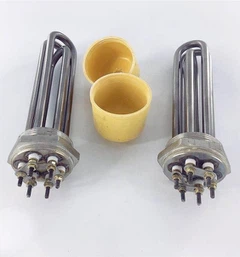
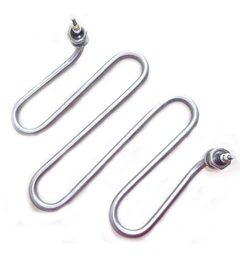
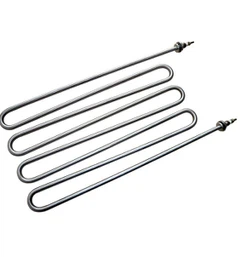
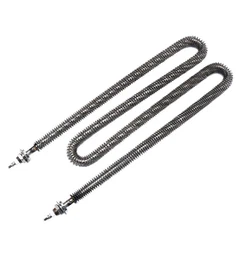
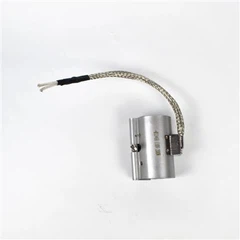
Cartridge heater is often used in industrial applications, such as in machinery or equipment that require precise heating. The heater is shaped like a cartridge, with a cylindrical body and two wires extending from one end. It can be inserted into a hole or clamp in the component, and the electrical current passing through the wires heats up the cartridge.
The seamless metal jacket on this cartridge heater element is made from a single piece of metal, providing excellent jacket integrity for high altitude and high stress applications. Deep drawing eliminates the risk of solder failure when equipment reliability is critical.
It provides localized and precise heat.
The cartridge heater is the "heart" of the thermal controller and the core heating component. It is responsible for efficiently converting electrical energy into thermal energy, thereby continuously providing precise and stable heat to the circulating heat-conducting medium.
The thermal controller itself does not generate heat. Its heating function is entirely dependent on the built-in cartridge heating element. When it is powered on, the internal resistance wire heats up, converting electrical energy directly into heat energy. Then, the heat is transferred through the metal tube wall (usually stainless steel or nickel-based alloy) to the heat-conducting medium flowing over its surface.
Cartridge heater for thermal controller is usually linked with the advanced PID temperature control system. The system continuously monitors the medium temperature through temperature sensors and quickly adjusts the power output of the heating element (usually controlled by solid-state relays for on-off operation). This enables the thermal controller to maintain the medium temperature within a range of ±1℃ or even smaller from the set value, meeting the requirements of precise production processes.
The cartridge heater is the energy core of the thermal controller. It precisely and efficiently converts electrical energy into thermal energy, and transmits a constant temperature to the production equipment (such as molds) through the circulation system. It is a key component that ensures product quality, enhances production efficiency, and enables process automation. Its performance and reliability directly determine the temperature control accuracy, heating speed, and overall stability of the mold temperature machine.
Concerning the cartridge lead wire,the following can be your reference:
1.Conventional high temperature wire: is our most common lead wire, it can withstand the temperature is 100-400℃.
2.Mica high temperature wire: used for air dry burning cartridge heater, the lead wire will also be exposed to high temperature, it can withstand the temperature is 500-600℃.
3.Pure nickel wire: It is also a very high temperature resistant lead wire, the temperature is used at 700 ° C.
4.Ceramic bead lead: when the temperature is relatively high, it can withstand 700-800℃.
5.Metal hose lead wire: often used in the case of lead friction.
6. PTFE wire: generally used when heating corrosive liquids, with a certain corrosion resistance.


Small Diameter, Miniature Cartridge Heaters Selection Guide
How much wattage is required?
What voltage will be used?
What is the heated length? What is the overall length?
How long are the heater leads or what is the lead length required?
What is the dimentions of the cartridge heater?
What is the ambient temperature the cartridge heater will see?
What is the maximum temperature required from the heater?
How quickly do you want to reach your operating temperature or set point in hour/minutes? What is the type and weight (in lbs.) of the material you want to heat? Special Modifications
Patented high-temperature design provides these advantages:
When energized, the patented split-sheath expands into contact with surrounding bore for maximum heat transfer, fast response.
When de-energized, the split-sheath contracts for easy, slide-out removal. Sunrods are guaranteed never to sieze in the bore.
Uninterruped hot zone and fully heated tip provides unmatched heat distribution without cold spots.
Slender continuous leads simplify wire management. High flexibility allows free motion when heating "floating" components.
The result is a miniature cartridge heater offering longer life, uniform temperatures, and easy installation in the smallest devices.
Application
Cartridge heaters are most frequently used for heating dies, platens, molds, and other metal parts by insertion into drilled holes. They can also be used in liquid immersion applications. Below are some examples of specific applications:
Heating gases and liquids
Hot runner molds
Hot stamping
Laminating presses
Medical equipment
Semi-conductor Plastic molding Scientific equipment
We have a vast range of quality cartridge heaters which includes heating mould tools, Tooling, Platens, Packaging Machinery, Heat Sealing Equipment, Plastic Process Machinery, Food Process Machinery and much more!
Hot Tags: Cartridge heater for thermal controller, China, suppliers, manufacturers, factory, customized, wholesale, free sample, made in China, DC 36V 400W Stainless Steel cartridge heating element, DC Cartridge Heating Element, Square Cartridge Heating Element, low temp DC heating element, mould cartridge heater, DC pencil heating element


